The following is a reflection upon praying The Glorious Mysteries while simultaneously going through The Stations of the Cross. Each Mystery matches with three Stations, including the optional fifteenth station.
If you’ve never prayed a rosary, there are many variations and optional add-on elements, but the best way to pray it is to just pick one you like and start praying it rather than worry whether you’re doing it right. Here is a brief overview of all the mysteries with a how to guide at the end. Here is a guided meditation specifically for The Glorious Mysteries.
The Creed, Our Father, Three Hail Mary’s
The traditional opening of the Rosary. The three Hail Mary’s we pray for the virtues of Faith, Hope, and Love. As a precursor to the First Station of the Cross, it’s almost as if we’re in the Garden of Gethsemane with Christ, praying for strength to prepare for the journey ahead. That is why we as Christians restate our faith in the Creed - to ground us in the fundamental metaphysical reality of this world and to remind us as a light when things get dark, as we know they will on the Via Crucis, The Way of the Cross.
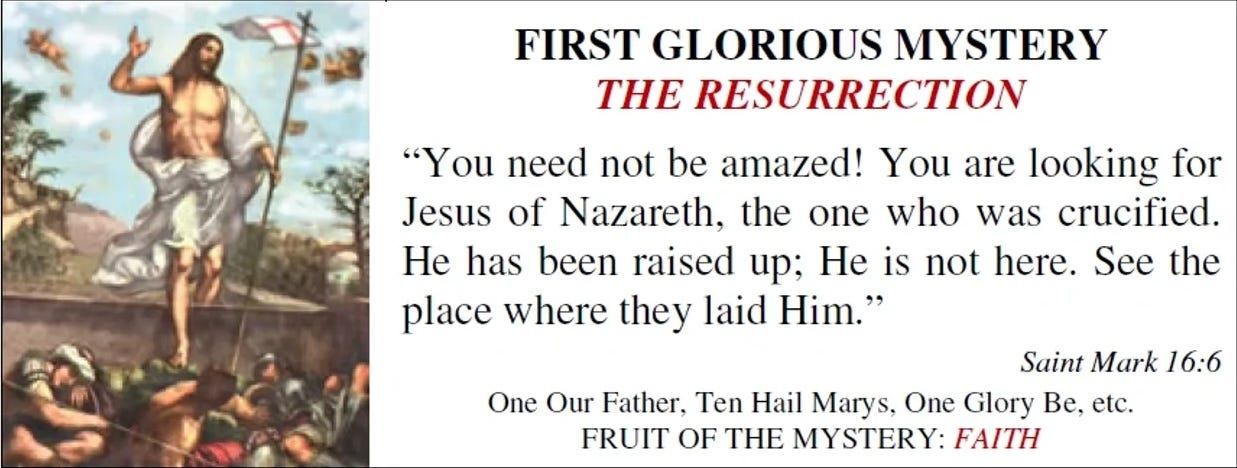
The First Glorious Mystery – The Resurrection
The Fruit of the Mystery – Faith
I. Jesus is condemned to death
Memento Mori - Remember Death. All men, all women, every human placed on this earth has, like Christ, been sentenced to death. We all stand, like Christ, condemned, at the beginning of a Via Crucis. Even Herod and Pilate, the Chief Priests and the Emperor too will die - ultimately they are not in charge.1
This is the start of the Christian life, which Christ models for us. We are struck with the unjustness of the condemnation, and yet we also know we stand justly condemned.
But it is here that the great rescue mission begins. “For God so loved the world, that he gave his only Son, that whoever believes in him should not perish but have eternal life.”2 “For as in Adam all die, so also in Christ shall all be made alive.”3 “The last enemy to be destroyed is death.”4
The only way out is Faith in the Resurrection, the triumph over death.
II. Jesus takes up his Cross
Albert Camus - “There is but one truly serious philosophical problem and that is suicide. Judging whether life is or is not worth living amounts to answering the fundamental question of philosophy.”
The Buddha “taught the four noble truths: the truths of suffering, the cause of suffering, the cessation of suffering and the path to the cessation of suffering.”5
In contrast to these, hear the words of Christ - “Take up your cross and follow me.”6
The Christian does not view whether life is worth living to be a truly serious philosophical problem, nor does he view it as his place to judge. He accepts it as a given. The Christian agrees with the Buddhist of the fundamental reality of suffering, but he does not view its elimination as the fundamental purpose of life and the highest good.
For the Christian, the highest good in life is love, and thus the fundamental choice in life is whether or not he will accept his cross and suffer well for what he loves.
This is why the Christian reminds himself of his creed and arms himself with the Christian virtues, the first of which is Faith. With the creed, Faith, and Hope, the Christian need not fall into the despair of Camus. And with the creed and Love, the Christian knows the purpose of life is greater than simply seeking an end to suffering.
We don’t necessarily know the sufferings we will endure, or maybe we do, but we will need Faith, Hope, Love, and Christ’s example to endure them either way, because the Christian knows he will suffer, and has as his highest good redeeming it rather than avoiding or eliminating it.
III. Jesus falls the first time
Immediately after taking up His cross, Christ falls. Similarly, we too fall in our weakness. We experience setbacks, and can’t live up to our original ideals and aspirations.
To fall and fail so soon might sow doubt, but that’s why the fruit of the First Mystery is Faith. We can’t do it ourselves. This is why Christ assumed our humanity - He became weak so that we might become strong.7 He fell so that we could rise, because He wants to unite us to Himself.8 We should not lose Faith if we fall.
The Second Glorious Mystery – The Ascension
The Fruit of the Mystery – Hope
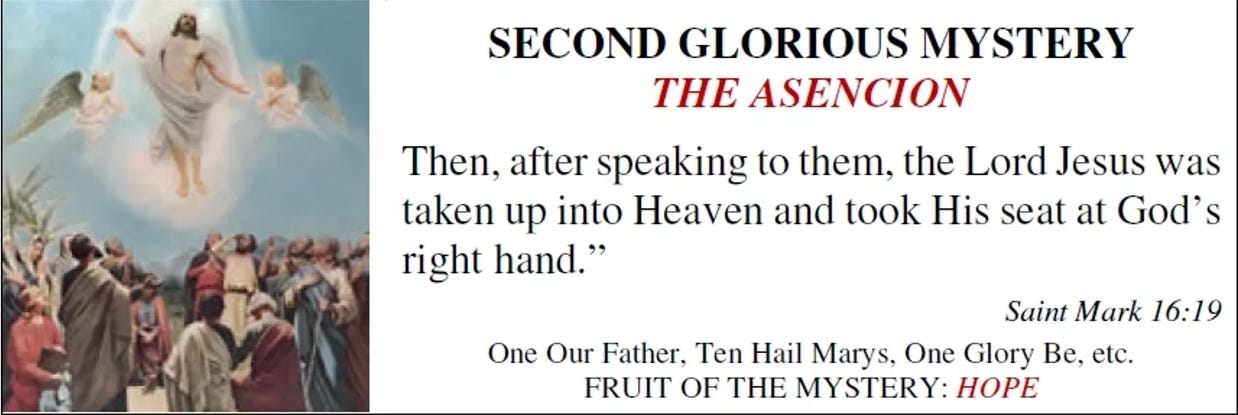
Unlike the Resurrection, which required the virtue of Faith in what was not yet seen, the Ascension produces the virtue of Hope as we see the first fruits of the resurrection of the body. In life, you need Faith in what you know to be true, even though all the evidence seems to point to despair - Hope though is sent to us to encourage us once we have some evidence of success.
Here we see three events of encouragement, sent to aid Our Lord as well as us. A temporary respite in the Via Crucis. These three stations parallel the 40 days before the Ascension, where Christ provides us comfort and strengthens the Apostles before he sends them them out into the world.
IV. Jesus meets his Mother
First Christ meets his Mother, whose support and encouragement aids Him. She strengthens Christ and provides Him hope. Likewise, so too does she support, encourage, strengthen, and aid us, since she is also our Mother.
V. Simon of Cyrene helps Jesus carry the Cross
Just as Simon of Cyrene was sent to aid Christ in the carrying of His cross, so too will we find friends and allies sent to help us on our way of the cross. Even though we all have our own cross to bear, it is not completely ours alone to bear.
VI. Veronica wipes the face of Jesus
Veronica wiping the face of Christ provides him with more support. Potentially historically linked to the Shroud of Turin, Veronica’s Veil also adds to our Hope as evidence of the Resurrection, sent by Christ to whisper to us even down into the 21st century.9
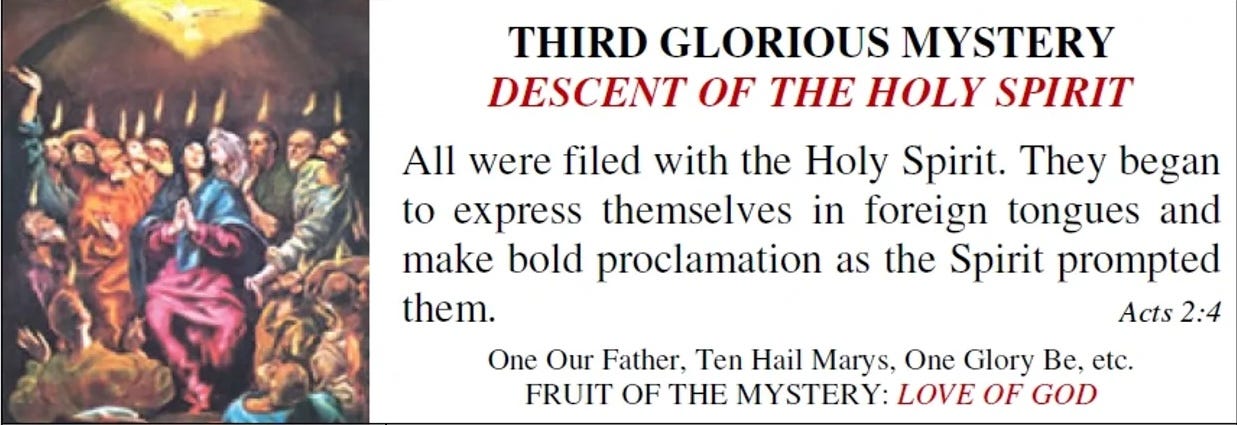
The Third Glorious Mystery – The Descent of The Holy Spirit
The Fruit of the Mystery – The Love of God
VII. Jesus falls for the second time
Christ falls again. The grace of Confession comes to mind while meditating on the Third Mystery. Love of God is what we require in order to avoid sin, it is what we lose when we sin, it is what is restored to us when we repent, and it is what spurs us to repentance.
Christ’s physical weakness highlights our own. “To fall into sin is not the most serious thing; more serious is to lie stretched out and refuse to struggle to rise again after we have fallen, to give in to apathy and to mask the weakness of our will with thoughts of despair.” - St. John Chrysostom.
VIII. Jesus meets the women of Jerusalem
As Jesus speaks to the Daughters of Jerusalem10 He symbolically warns of future persecutions in the Church. In order to stand firm in such times, there is a need for the Holy Spirit, the Comforter.11
As the Apostles showed between the Resurrection and the Descent of the Holy Spirit, without Christ we can do nothing. Like the women of Jerusalem, we are powerless against empires, but with the Holy Spirit we can do all things.12
IX. Jesus falls for the third time
As Christ falls for a third time, and as we too fall again and again, we may be tempted to despair and doubt God’s love and forgiveness. But the Lord never tires of forgiving us, 7 x 70 times or more, always welcoming us back like the Prodigal Son.13
Remember, before sin is committed it is Satan who says it’s no big deal and Christ who says it is - but after sin is committed it is Christ who says it's no big deal and Satan who says it is.14
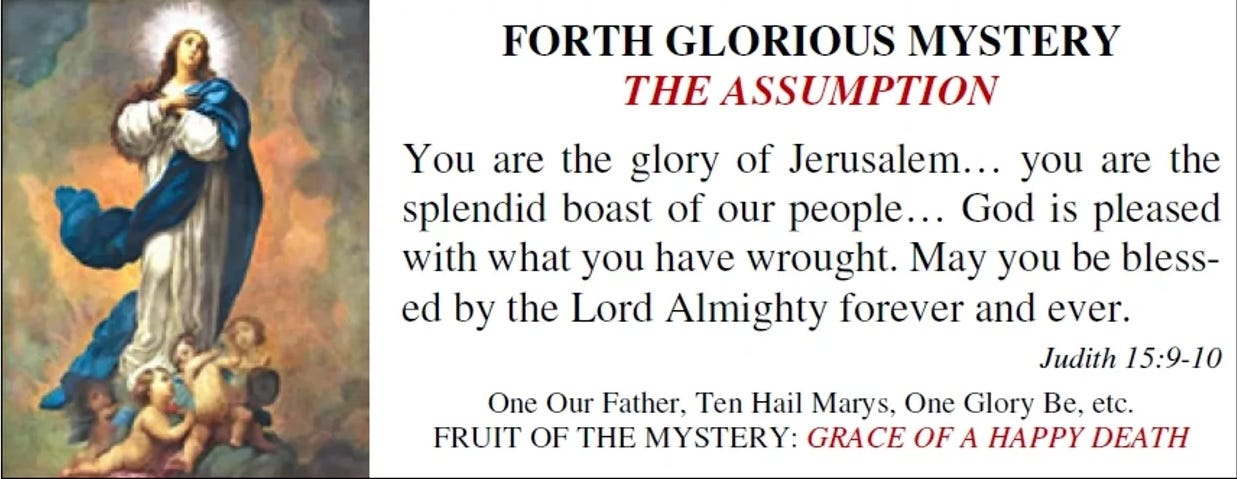
The Fourth Glorious Mystery – The Assumption
The Fruit of the Mystery – Grace of a Happy Death
X. Jesus is stripped of his garments
Christ experienced the humiliation of His divine body in order to ultimately exalt the human body through the Resurrection. The Assumption of Mary provides a foretaste of that exaltation and shows us what is in store for us too. This let’s us face death without fear. At the same time, we know that humiliation is not necessarily contrary to a Happy Death, as long as death is faced rightly, for and in Christ.
XI. Jesus is nailed to the Cross
Nor is pain and suffering necessarily against a Happy Death, as shown by Christ’s death on the cross.
As Christ was lifted up, so Mary was too, and so too we will be.
XII. Jesus dies on the Cross
At Christ’s feet are St. John and Mary, His Mother.15 John, who lived a white martyrdom, like Mary, shows us a different way we can die a Happy Death.
A Happy Death can be peaceful, where the cross is remaining faithful throughout our lives, serving God in the long struggle against sin, in addition to being a more violent death. There are many types of suffering, but the Christian’s heroism is in bearing the particular suffering we have been given well.
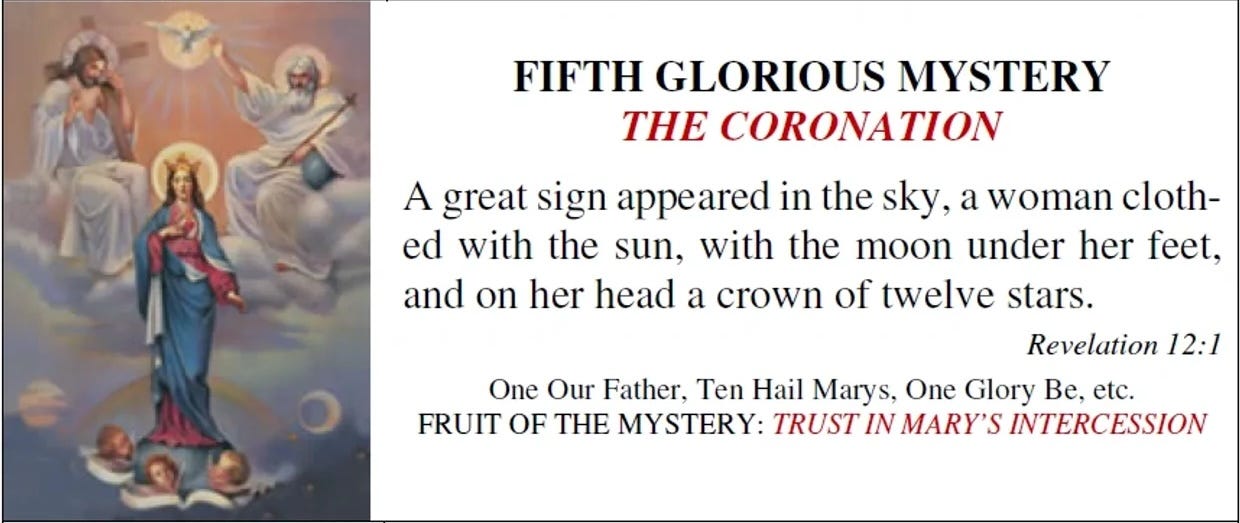
The Fifth Glorious Mystery – The Coronation of Mary as Queen of Heaven
The Fruit of the Mystery – Trust in Mary’s Intercession
XIII. Jesus is taken down from the Cross
Despite Mary’s faith, she may not have understood exactly how things were going to work out in this moment, when the sword pierced her heart.16 And yet, she trusted, and that trust serves as a model for us. Like her, even when we don’t understand, we should offer our prayers in a spirit of trust - trust in Christ who offers them to the Father, and Trust in Mary’s Intercession when we ask her to intercede for us with her son.
XIV. Jesus is laid in the tomb
Just as Mary offered Christ to the tomb, so does she offer our prayers to Christ.
Just as she received Myrrh at Christ’s birth, so now does she fully understand its meaning.
Just as Mary gave birth to Christ into the world, so now does she witness to His new birth - from the tomb in the Resurrection, giving new life to the world.
XV. The Resurrection
The triumph of Christ the King of the Universe parallels the Coronation of Mary Queen of Heaven, where she fulfills her role as the queen mother of the eternal Davidic kingdom. This is why we can Trust in Mary’s Intercession - as the Queen Mother, whatever Mary asks Christ will give. As at the Wedding at Cana, so now at the Wedding Feast of the Lamb.17
“You would have no authority over Me, unless it had been given you from above.” John 19:11
John 3:16
1 Corinthians 15:22
1 Corinthians 15:26
The Dalai Lama October 7, 1981. Translated, clarified, and edited to its current form November 5, 1982 - https://www.lamayeshe.com/article/four-noble-truths
Matthew 16:24; Mark 8:34; Luke 9:23
Christ, “though he was in the form of God, did not count equality with God a thing to be grasped, but emptied himself, by taking the form of a servant, being born in the likeness of men. And being found in human form, he humbled himself by becoming obedient to the point of death, even death on a cross.” Philippians 2:6-8
“He has granted to us his precious and very great promises, so that through them you may become partakers of the divine nature, having escaped from the corruption that is in the world because of sinful desire.” 2 Peter 1:4
For the historical linking of the Shroud of Turin (the alleged burial cloth of Jesus) to the Veil of Veronica through the Image of Edessa/Mandylion, see pp. 408-410 of The Founding of Christendom, Volume 1 of Warren H. Carroll’s The History of Christendom Series. The evidence for the authenticity of miraculousness of The Shroud of Turin deserves its own article, or perhaps its own book. Just one piece of evidence will do for this footnote – there is an imprint on the cloth, over one of Christ’s eyes, of six clearly identifiable Greek letters from a Roman coin minted only by Pontius Pilate, only in Palestine, and only in the sixteenth, seventeenth, and eighteenth years of the Emperor Tiberius – October 28 A.D. – October 31 A.D. Id. at 353.
“And there followed him a great multitude of the people and of women who were mourning and lamenting for him. But turning to them Jesus said, ‘Daughters of Jerusalem, do not weep for me, but weep for yourselves and for your children. For behold, the days are coming when they will say, ‘Blessed are the barren and the wombs that never bore and the breasts that never nursed!’ Then they will begin to say to the mountains, ‘Fall on us,’ and to the hills, ‘Cover us.’ For if they do these things when the wood is green, what will happen when it is dry?” Luke 23:27-31.
John 14:16, 26
Compare John 5:15 “Without me you can do nothing” with Peter before the Sanhedrin in Acts 4:5-22. See also Luke 12:11-12 “And when they bring you before the synagogues and the rulers and the authorities, do not be anxious about how you should defend yourself or what you should say, for the Holy Spirit will teach you in that very hour what you ought to say.” And of course Philippians 4:13 - “I can do all things through Christ who strengthens me.” How does Christ strengthen Paul? Through the sending of the Holy Spirit - Filioque.
“Then Peter came up and said to him, ‘Lord, how often will my brother sin against me, and I forgive him? As many as seven times?’ Jesus said to him, ‘I do not say to you seven times, but seventy-seven times.’” Matthew 18:21-22. See also, of course, the Parable of the Prodigal Son.
“Pay attention carefully. After the sin comes the shame; courage follows repentance. Did you pay attention to what I said? Satan upsets the order; he gives the courage to sin and the shame to repentance.” St. John Chrysostom.
“The devil deceives men in two ways, ‘By despair and by hope.’ After the sinner has committed the sin, he tempts him to despair, through fear of the Divine Justice; but before the sin is committed, he tempts the sinner to commit it, by telling “him of the Divine Mercy. Therefore the saint warns every one, by saying, ‘After sin, hope for mercy; before sin, fear justice.’” St. Alphonsus Liguori, citing St. Augustine.
“When Jesus saw his mother and the disciple whom he loved standing nearby, he said to his mother, ‘Woman, behold, your son!’ Then he said to the disciple, ‘Behold, your mother!’ And from that hour the disciple took her to his own home.” John 19:26-27. In this verse, Christ gives Mary to be the Mother of St. John, and by extension, all of us as the New Eve.
Luke 2:35
Revelation 19:6-9

Comments